The Street Name That Outlasts the Street
Learn how an old street name can point toward earlier land use or settlement, and how to investigate its clues without mistaking a clue for proof.
The common mistake with an old street name is treating it as a caption for the present-day landscape. A road called Mill Lane may have no mill beside it, and a street called Orchard Road may be lined with apartment buildings. The cost is a tidy story mistaken for a documented one: place names can preserve traces of earlier land use or settlement, but a name alone cannot establish exactly where it came from.
To see how to read that clue carefully, follow one invented case from a modern street sign back through a set of maps and records. The place, records, and findings below are fictional. The method is useful precisely because it leaves room for more than one explanation.
What does Mill Lane tell us at the start?
Imagine you are looking at a town map and notice Mill Lane, a short street running between a shopping strip and a housing development. The nearest stream now passes through a culvert, and no mill appears on the current map. A local directory lists shops and houses but says nothing about milling.
That is enough to pose a question, not enough to answer it. “Mill” could refer to a working mill, a remembered landmark, a family name, or a name chosen later because it sounded familiar. “Lane” may describe an older track, but it can also remain in a street name after a route has been widened or rebuilt.
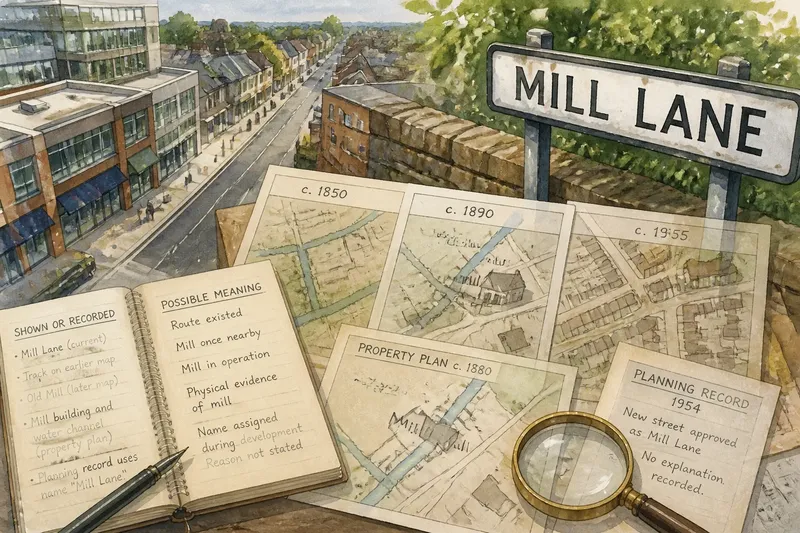
Begin by recording what can be checked directly: the present street name, its spelling, the street’s position, nearby watercourses, and the date or edition of each map you consult. Keep the observations separate from interpretations. A notebook with two columns—“shown or recorded” and “possible meaning”—is a plain tool for preventing a guess from quietly becoming a fact.
Which older maps are worth comparing?
In the invented case, the first useful source is a sequence of town maps from different periods, not a single older sheet picked because it looks convincing. On an earlier map, the street itself is absent, but a narrow track follows roughly the same corridor. A later map labels a building near the stream as “Old Mill.” A still later plan shows the track widened and connected to new housing.
Those map labels provide a plausible chain: a route existed, a mill was marked nearby, and the modern street developed along or near the old route. They do not prove that the modern name was formally inherited from the mill. The name might have been adopted when the new street was laid out, perhaps to recall a local feature already disappearing.
Compare features that can be located, rather than relying on visual resemblance alone. A stream bend, a bridge, a church, or a junction may help align old and current maps. Mapmakers sometimes simplify, omit, or shift details, and the same name may be placed differently across editions. Treat an old map as evidence made for a particular purpose, not as a perfect photograph of the ground.
What records can help explain the name?
Next, the fictional investigator checks sources that might record naming decisions or land use: street directories, property plans, local histories, planning records, and archival map catalogs. A directory could show when “Mill Lane” entered common use. A property plan might mark a millrace or mill building. A planning document could explain that the street was named during a housing development.
In this invented case, a property plan shows a mill building and a water channel near the earlier track. A later planning record uses “Mill Lane” for the new street, but gives no explanation for choosing that name. The evidence now supports two separate statements: a mill once stood nearby, and the modern street was assigned a name that refers to a mill. It still does not establish whether the naming authority intended to commemorate that specific building.
That distinction matters. A name can preserve a trace without preserving a complete account. Records may be missing, inconsistent, or silent about motives. If a source identifies a person or business called Mill, that too could be relevant; the word need not refer to the machinery or building most readers first imagine.
How can the route’s physical setting add context?
The stream and track make the mill interpretation more plausible in this fictional case, but physical setting should be used as context rather than a shortcut to certainty. A mill needs a power source or another way to operate; a mapped stream makes water-powered milling conceivable, but does not by itself show that a particular mill stood there. The building symbol and property plan carry the more direct evidence.
Names also outlast changes in land use because street names are useful for orientation and addresses. Once a name is adopted, residents, postal services, maps, and public records may keep using it even as fields become housing and waterways are covered. The name behaves a little like a label on a storage box: the contents can change, while the label remains useful—and sometimes misleading.
In the case, the old track is widened, the stream is culverted, and the mill disappears. Mill Lane survives because it identifies the street, not because the present landscape continues to resemble the earlier one. This is a common way for place names to carry fragments of an older settlement into a changed environment.
What should you conclude about an old street name?
Say you are preparing a short local map note about this fictional Mill Lane. You have the current street sign, an older map marking a track, a later map labeling a nearby mill, and a property plan showing a mill building and channel. You write that the name “may recall a former mill near the earlier route,” then note that the records do not explain the naming decision. The observable result is a useful, cautious account: readers can see why the interpretation is plausible and where its limits lie.
That wording is stronger than either extreme. “The street was named after the mill” claims a direct origin the record does not provide. “The name means nothing” ignores the converging clues. Good place-name interpretation distinguishes a documented fact, a supported possibility, and an unresolved question.
When you encounter a name that seems out of place, check the spelling across sources, look for the earliest appearance you can locate, compare maps from different periods, and seek records that connect the name to a feature or naming decision. Also consider alternative readings: a surname, a former business, a nearby landmark, or a later commemorative choice can produce the same wording.
The search phrase “old street names and their origins” often suggests a single answer waiting in an archive. In practice, an old street name is more like a small signpost toward evidence: it can direct attention to vanished routes, land uses, and settlements, but the evidence decides how far the story can go. For Mill Lane, the best account is not that the name proves a mill’s exact history; it is that the name, maps, and property record together make a former mill a credible part of the street’s past.
What questions help separate a clue from proof?
Does a name like Mill Lane prove a mill stood there?
No. It identifies a possibility to investigate, while maps, property records, directories, or other local documents may provide independent support. The name alone does not establish a building’s location, use, or connection to the present street.
Why can a street keep an old name after the landscape changes?
Names help people identify routes and addresses, so they may remain in use after fields, streams, or buildings have changed. The name can preserve a reference to an earlier feature without describing what is visible now.
Which source should I check first?
Start with the earliest map or record you can locate that shows the name, then compare it with maps that show the surrounding area before and after the street appeared. A local archive, library catalog, or municipal records office may help identify relevant property and planning documents.
What if the name has several possible origins?
Keep each explanation distinct and state what supports it. If the surviving sources do not settle the question, describe the origin as uncertain rather than selecting the most appealing story.
The most useful outcome of investigating Mill Lane is not a dramatic claim but a clearer boundary between what the landscape once contained and what the surviving name can actually tell you. Preserve that boundary in a map note or local history, and the name remains a clue rather than an accidental piece of false certainty.